Guide
Custom Printed Pouches: A Buyer Guide for UK Brands
To order custom printed pouches, start with what you are packing, the fill weight or volume, the filling process and the protection your product needs. Choose the format and material together, then confirm quantity per design and prepare artwork on the approved dieline. The Pouch Works reviews your specification before quoting; eligible standard formats start from 500 units per design, while specialist and spouted minimums are confirmed individually.
1. Choose the pouch format around the product
A pouch should work when filled, opened, stored and transported — not just look attractive in a mock-up. Start with how the customer will use it and whether it needs to stand on a shelf, reseal or dispense a liquid.
The same brand may need different formats across its range. A dry snack and a sauce do not share a specification just because the artwork looks similar.
Compare stand-up pouches, flat pouches and sachets, spouted pouches and coffee bags.
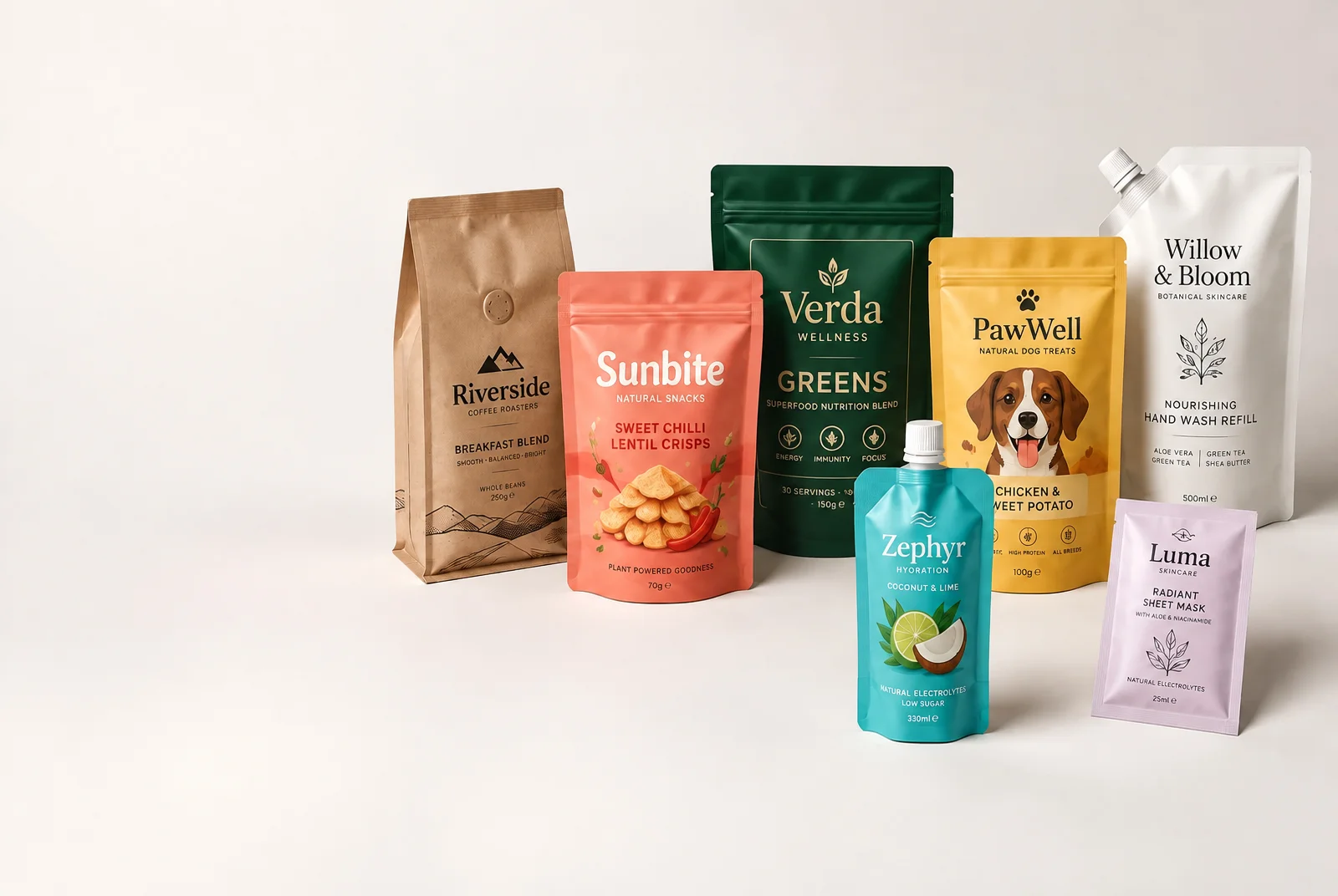
| Format | Applications to consider | What to check |
|---|---|---|
| Stand-up pouch | Coffee, snacks, powders and dry pet treats | Filled stability, gusset, zip and barrier |
| Flat pouch or sachet | Single-use portions and compact packs | Fill space, seal margins and opening |
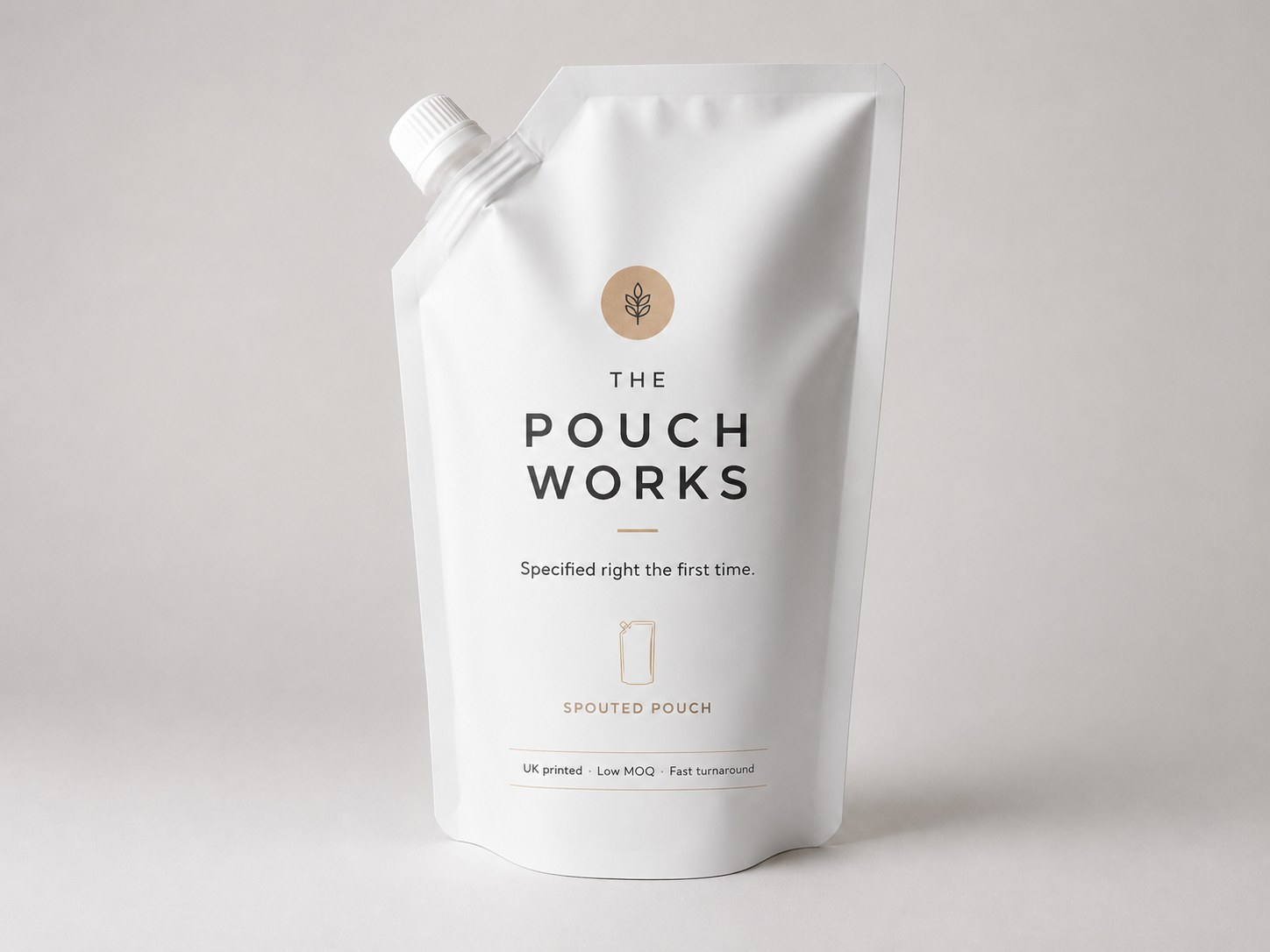
| Spouted pouch | Drinks, sauces and liquid refills | Formula compatibility, cap, spout and filling process |
| Coffee or tea packaging | Beans, ground coffee and loose-leaf tea | Aroma protection, closure and any valve requirement |
2. Match size and material to shelf-life requirements
Tell us the product and target fill weight or volume. Outer width and height do not determine usable capacity on their own: gusset depth, seals, closures, headspace and product density also matter. Start with the pouch sizes guide, then confirm the proposed size against the actual product.
Describe the protection needed against oxygen, moisture, light, grease or aroma loss. A clear window shows the contents but changes light exposure; foil or metallised structures may provide stronger light protection. Read barrier films explained rather than choosing a laminate by appearance alone.
For liquids, include the formula, consistency, particles and filling temperature. Hot fill, pasteurisation and retort require specific review of the laminate, seals, spout and cap. Recyclability also needs confirmation for the complete construction and its intended collection route; a material name alone is not a disposal instruction.
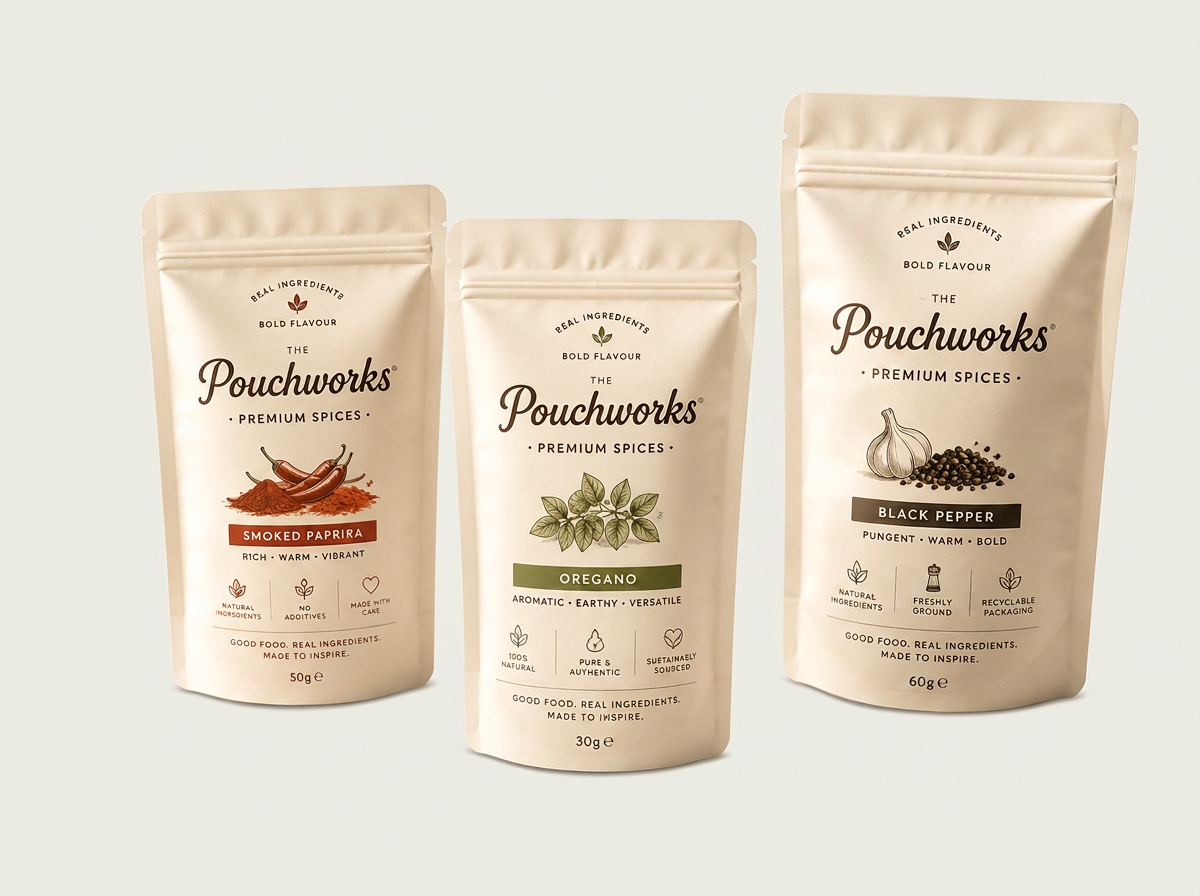
Compare clear film, metallic foil, matte white and kraft paper options against the protection your product needs.
3. Choose printing, finishes and practical features
Our standard range uses digital printing. It supports full-colour artwork and separate designs without engraved printing plates. Other production requirements depend on the construction and volume; compare the practical differences in digital versus flexo printing.
A resealable zip, tear notch, valve or spout should have a job to do. A coffee valve is not a substitute for barrier material, and a cap must suit the product's flow and the filling equipment. Confirm feature placement on the dieline before approving artwork.
Ask about matte, gloss or specialist finishes against your chosen structure. Additional finishing can affect the available minimum, cost and schedule; do not assume every finish is available on every film.
4. Check minimum orders and compare like-for-like quotes
From 500 units per design for eligible formats; specialist specifications may require more.
Specification-dependent. Some mono-material spouted constructions require 5,000 units; we confirm the minimum before quoting.
Count quantities per artwork design, not just across the whole order. For an eligible specification, four designs at 500 each are a different job from 2,000 pouches with one design. Read minimum order quantities explained before planning a multi-flavour launch.
Compare quotations using the same dimensions, material, features, finish and quantity per design. Confirm what is included for artwork work, delivery and tax, and ask which approvals or material availability affect the schedule. The pricing guide explains the cost drivers without promising a fixed price or universal saving.
5. Prepare artwork after the specification is confirmed
Use the dieline supplied for the final format and dimensions. Keep essential text and barcodes out of seal areas, gusset folds and fitment zones. Supply print-ready PDF or AI artwork in CMYK with the specified bleed; the artwork setup guide covers the checks in detail.
Review the digital proof before approval, including copy, colours, dimensions and feature placement. Standard production is typically 2–4 weeks from artwork approval; specialist timing is confirmed for the selected construction and current capacity. Allow time for specification decisions and artwork revisions before that production window.
If you need design help, state that in the quote enquiry rather than preparing files for an unconfirmed pouch size.
6. What to send for a useful pouch quotation
You do not need to know every technical answer before enquiring. Supply the details you have, identify anything uncertain and let us review the options. A specific brief is more useful than a request for a price against a photograph.
Tell us what you are packing through Get My Pouch Quote.
| Detail | Information to include |
|---|---|
| Product | What is being packed and any compatibility or shelf-life requirements |
| Fill | Weight for dry goods or volume for liquids; proposed dimensions if known |
| Format and material | Your preference, or ask for advice |
| Features | Zip, valve, tear notch, finish or spout and cap requirements |
| Quantity | Desired quantity per design and the number of artwork designs |
| Artwork | Print-ready files, existing branding or a need for design help |
| Schedule | Target delivery date and any launch dependencies |
| For spouted pouches | Consistency, filling temperature, spout position and cap preference |
- We check the specification and production requirements.
- Receive pricing and an indicative timeline within one working day. No account, payment or obligation is required to enquire.
Not sure which pouch size you need? Tell us what you are packing and we will check the specification.
Get My Pouch Quote →Related questions
Quick answers
What is the minimum order for custom printed pouches?
From 500 units per design for eligible formats; specialist specifications may require more. Specification-dependent. Some mono-material spouted constructions require 5,000 units; we confirm the minimum before quoting.
Can I request a quote without knowing the pouch material?
Yes. Send the product, fill weight or volume, desired quantity and any shelf-life or filling requirements. We can review suitable materials and identify the details that need confirmation.
When should I prepare my pouch artwork?
After the format, dimensions and features are confirmed. Use the matching dieline, keep important content clear of seals and folds, and approve the digital proof before production.
How long does custom printed pouch production take?
Standard production is typically 2–4 weeks from artwork approval. Specialist constructions, material or fitment availability and current capacity can change the schedule; your quotation confirms the indicative timing.
Still have questions? Email hello@thepouchworks.com and we'll get back to you within one business day.